
Elementary Lesson Plan A
Theme: The Call to Be Disciples Who Put Love in Action
Materials Needed
- Newsprint (or dry erase board) and markers. You may want to pre-write the quotes from Faithful Citizenship on newsprint.
- Bible, with enthronement and candle, if possible
Gathering
The first task in each session is to establish a sense of welcome and hospitality. The second task is to begin the session with the child's human experience, i.e. the child's "story." Located prominently in the room should be an enthronement of the Bible, with candle. Gather around the Word for prayer.
Open the session by drawing a simple picture of a church on the chalkboard. (This can be as simple as a square with a triangle above it, with a cross above that, as in the graphic below.)
Next, draw a large circle around the church, as shown below.
Ask the children, "What do you think this circle represents?" After allowing some responses, explain that the circle represents the world.
Instruct the children, "Name some problems that affect people or communities in the world." (e.g. poverty, wars, sickness, etc.). Write their responses in the area inside the circle but outside the Church.
Point out that the picture of the Church is inside the picture of the circle. What does that represent? The Church exists within the world.
Finally, draw a heart that encompasses both the Church and world. 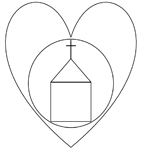
Ask the children what they think the heart represents. After allowing some responses, explain that the heart represents two things. First, the heart represents the great love that God has for the world and for all the people in it, including all of us. Second, the heart reminds us that as disciples, we are called to imitate Christ's love by extending his love to everyone. The Church exists within the world, and so we are concerned about all the problems that God's children all over the world face. As disciples of Christ, we are called to love God, and we are also called to love our neighbors who are both near to us and far away.
Opening Prayer
Gather around the Word to pray a simple opening prayer and proclaim the Word of God.
Let us pray.
Loving Father, we thank you for calling us to be disciples of your Son, Jesus Christ. Spirit that guides us, help us to be disciples who put love in action. We ask this through Christ our Lord. Amen.
Students are seated. Catechist takes Bible from enthronement and proclaims reading. Be sure reading is marked in advance.
Scripture Reading & Faith Sharing
The catechist makes the transition to this movement by describing that Jesus teaches us how to be disciples who put love in action. He tells us we have to love God and also "love one another." Prior to proclaiming the reading the catechist may wish to prepare the children for some of the strong language in this passage, e.g. hate and murder. However, avoid too much "explaining" before the proclamation.
Proclaim the reading from Mark 12:28-34
(Note: The same reading is used in the Adult Small Faith Community Sharing and the High School Lesson Plan so that the sessions can be intergenerational, if desired):
A reading from the Gospel of Mark…
After the reading a brief period of silence follows. Then, the catechist asks the children these or similar questions:
- What happened in this reading?
- What question did the scribe ask to Jesus?
- What did Jesus say are the two most important commandments?
After the children's initial response,proclaim the reading again, asking the children to listen to what Jesus says about loving others.
A reading from the Gospel of Mark…
- As disciples of Jesus, who are we called to love? (God and neighbors)
- Who is your neighbor? Is Jesus talking just about the people who live next door, or about all people?
- Is it harder to love God, or to love other people?
- Can you tell me examples of how people sometimes hurt each other, instead of love each other?
- What are ways that you show other people you love them?
- What are ways you show God that you love him?
- Does loving people help us to love God better?
- Does loving God help us love people better?
Faithful Citizenship Reading and Discussion
The catechist makes a transition from reflection on the Scripture to discussion on the teaching of the Church.
- Our country is having an important election this year. Who knows what an election is?
- What can you tell me about the election?
The Church wants to help us be disciples that put love in action.
The bishops of the United States have written a document to help us be disciples who put love in action. (Refer to the pictures from the beginning of the session.) Remember, the Church exists within the world. If we want to show that we love God, we must love all the other people in the world and help those who are in need. We have to help take care of other people. We also have to help our leaders make good laws that help our neighbors who are in need.
For disciples who are citizens of the United States, voting is a very important way to put love in action. There are also many other ways we can be disciples who put love in action by caring for others.
- What are some ways that you care about others? (For example, "Treat Others Kindly." "Give money to the poor." "Make a card for someone who is sick." Etc.)
- Name some people in our community and in our world who need our love and concern. [You can also refer to the examples inside of the circle.]
The Church teaches that good disciples are concerned about:
- Protecting human life, especially unborn children.
- Peace and making our world better for all people.
- People living in poverty, who do not have enough food, or a safe place to live. Ending poverty and sharing with those who don't have what they need, particularly children.
The Church also says (write this quote on newsprint or blackboard):
"As Catholics we are called to participate in public life in a manner consistent with the mission of our Lord, a mission that he has called us to share."
- Forming Consciences for Faithful Citizenship: A Call to Political Responsibility (no. 1)
Break down the quote for the children by asking and answering the following questions:
- What does "participation" mean?
- How do you "participate" in your family? In your neighborhood? At school? On a sports team?
- What would happen if you went away for a week on a trip? Would your sports team, or your class at school be missing something or someone? (Yes! It would be missing you!)
- We can "participate" in our communities and world by working to make them better. When there is a problem, we can "participate" by working to address it. Can you think of examples of how we can do this? (Learning about issues or problems faced by others, educating your friends, doing service, voting, calling or writing a letter to your representative, etc.)
Explain that the bishops remind us that we are guided by our beliefs. One very important belief is that God loves us very much, and so we should love each other. They also remind us that we should work together to make our world better because we are followers of Jesus.
- How is working to make our world better is connected to being followers of Jesus?
- Do you think that children's voices matter? Why or why not?
- What can children do to make a difference?
Closing Prayer
Return to the adult gathering or return to the prayer circle. If praying in
the classroom, refer to the list on newsprint.
Using the ways to put love in action that the children brainstormed during the
questions, make a litany with the response being, "Lord, hear our
prayer." Catechist leads the litany using examples the children gave. For
example:
- Help us to put love in action by sharing with others as Jesus did. We pray to the Lord…
- Help us to put love in action by respecting all people by the way we talk and act like Jesus did. We pray to the Lord…
- Help us put love in action by picking up our trash and not wasting food. We pray to the Lord…
- Help us put love in action by speaking up for those who are weak or living in poverty. We pray to the Lord…
- Gathering our prayers into one, let us pray the prayer that Jesus taught us. Our Father…