Homily for the Mass for Solidarity with Bishops and Faithful of Africa
by Bishop Stephen Dami Mamza of Yola, Nigeria, 1st Vice President of SECAM
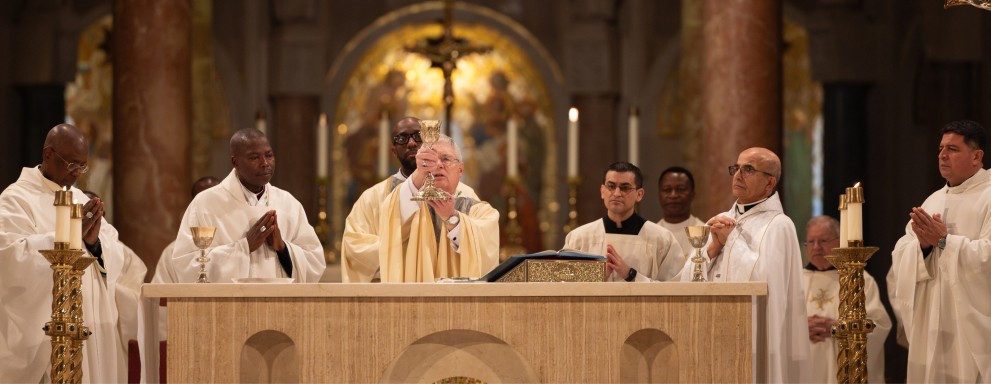
On February 4, 2026, the USCCB's Committee on International Justice and Peace in collaboration with the Justice, Peace and Development Commission of the Symposium of Episcopal Conferences of Africa and Madagascar organized a Mass for Solidarity with the Bishops and Faithful of Africa. The Mass was held at the Basilica of the National Shrine of the Immaculate Conception in Washington, D.C. and celebrated by Bishop David J. Malloy of Rockford, Illinois, Bishop Stephen Dami Mamza of Yola, Nigeria, and Bishop A. Elias Zaidan, chairman of the Committee on International Justice and Peace.
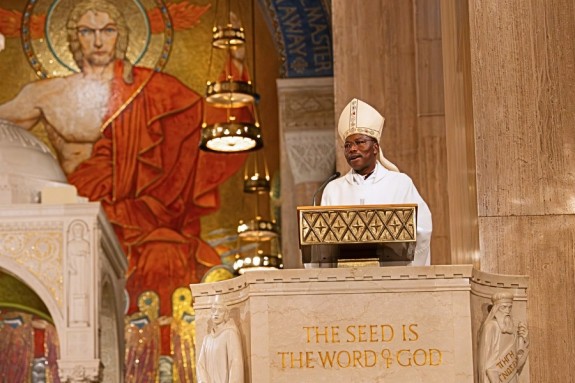
Bishop Mamza, who is the 1st Vice President of SECAM and president of its Justice, Peace and Development Commission, offered a homily on the importance of solidarity between the United States and Africa. The text of the homily is below (PDF available here).
Solidarity Between the Catholic Bishops of the United States of America and the Catholic Bishops of Africa
My brothers and sisters in Christ,
Grace and peace to you in the name of our Lord Jesus Christ, who gathers us as one Body, one faith, one baptism and one Church. I thank the International Justice and Peace Committee of the United States Conference of Catholic Bishops for the invitation to preach at this Eucharistic celebration. On behalf of the Church in Africa, I bring you greetings of good wishes.
I am Bishop Stephen Dami Mamza, the Bishop of Yola Diocese in North East Nigeria. Part of my Diocese is one of the main areas in North East Nigeria that was overran by the Boko Haram Insurgency between 2014 and 2017. The Boko Haram insurgency led to my deep involvement in taking care of the Internally Displaced Persons (IDPs) who ran for their lives to Yola, the state capital, looking for shelter.
I wish to use this opportunity to thank the universal Church for the show of solidarity we enjoyed from different parts of the world at the peak of the Boko Haram insurgency, especially some Church institutions in the United States through Mission Appeal, the Hungarian Government through Hungary Helps and particularly the Church in Germany through the Aid to the Church in Need, Missio in Aachan, and the Archdiocese of Cologne. These three Church Institutions in Germany are the reasons behind the survival of the Catholic Faith in many African Countries especially in North East Nigeria. Most of our Churches, Schools, Parish Houses and Hospitals destroyed by Boko Haram were rebuilt through the help of these Church Organizations in Germany. CRS presence was also there, along with other international humanitarian agencies, offering humanitarian services to everybody irrespective of religious affiliation.
SECAM, which is the Symposium of the Episcopal Conferences of Africa and Madagascar is the umbrella body of the entire Catholic Church structure in Africa and its Islands. The President is Fridolin Cardinal Ambongo, the Archbishop of Kinshasa in the Democratic Republic of Congo, representing the French-speaking countries. I am the first Vice President representing the English-speaking countries while an Archbishop from Angola, who is the second Vice President, represents the Portuguese-speaking countries. In SECAM, we have two major commissions: Justice Peace and Development Commission (JPDC) and Evangelization Commission. I am the President of the Justice, Peace and Development Commission, while the second Vice President presides over the Evangelization Commission.
My brothers and sisters in Christ, today’s Gospel from the Gospel of Mark is striking in its simplicity and in its challenge. “He was amazed at their lack of faith.” (Mk 6:6). Jesus returns to his hometown, to the people who know him best—or at least think they do. They know his family. They know his trade. They know his background. And because they think they know him, they cannot receive him. Familiarity hardens into disbelief. Closeness becomes an obstacle to faith. This rejection is not loud or violent. It is quiet, almost reasonable: “Is he not the carpenter, the son of Mary?” Yet it is precisely this quiet skepticism that amazes Jesus. Not anger, not persecution—but a closed heart.
Today, we proclaim this Gospel in a very particular context: a Solidarity Mass uniting the Bishops of Africa and the Bishops of the United States of America. This context invites us to hear Mark’s Gospel not only as a story about Nazareth long ago, but as a mirror held up to the Church today.
1. The Danger of Familiarity
Nazareth could not see beyond what was familiar. They reduced Jesus to what they already knew. And in doing so, they missed what God was doing in their midst. This is a temptation for the Church in every culture and every age. We can become so accustomed to our own ways of worship, governance, theology, and pastoral practice that we fail to recognize the Spirit speaking through voices that sound different from our own.
Africa and the United States come from different histories, cultures, and ecclesial experiences. Africa often brings to the Church a faith that is vibrant, communal, and resilient in the face of poverty, conflict, and persecution. The Church in the United States brings gifts of theological scholarship, institutional resources, and long experience engaging pluralistic societies.
Yet the Gospel warns us today: if we see one another only through the lens of stereotypes, power, or past assumptions, we risk becoming like Nazareth—too familiar with our own perspectives to recognize Christ speaking through the other.
2. Overcoming the Nazareth Within Us
The Gospel invites each of us—bishops, priests, religious, and lay faithful—to examine our own hearts. Where have we grown resistant to God because He speaks through unfamiliar voices? Where have we limited Christ by our expectations? Where have we failed to believe that God can work powerfully through those who do not look, think, or worship exactly as we do? Jesus leaves Nazareth and continues his mission elsewhere. Let us pray that he never has to “move on” from us because of our lack of faith.
Brothers and sisters, today Christ stands in our midst—African and American, north and south, rich and poor—not as a stranger, but as Lord. May this Solidarity Mass be an act of faith that amazes Jesus, not because of unbelief, but because of a Church willing to recognize him in one another.
May we not say, “Is this not the carpenter?” But instead proclaim with faith: “Truly, Christ is among us.” Amen.
Brothers and sisters in Christ, in the second part of this homily, I want us to reflect more deeply on a profound and urgent theme: the call to solidarity between the Catholic Bishops of the United States of America and the Catholic Bishops of Africa—a solidarity rooted not merely in shared mission, but in the very heart of the Gospel. Solidarity between the Catholic Bishops of the United States of America and the Catholic Bishops of Africa offers significant pastoral, social, theological, and global benefits for the Church and for society.
3. United in the One Body of Christ
Saint Paul reminds us in his First Letter to the Corinthians Chapter 12:26: “If one member suffers, all suffer together; if one member is honored, all rejoice together”. This truth is not metaphorical—it is ecclesial, sacramental, and deeply real. The Church in the United States and the Church in Africa are not two separate entities. They are two lungs of the same Body, breathing the same Spirit. What strengthens one strengthens the whole. What wounds one wounds all. When African bishops speak courageously about war, poverty, corruption, or threats to human dignity, their voices echo in American dioceses. When American bishops defend the sanctity of life, advocate for migrants, or confront the culture of individualism, their witness strengthens the Church in Nigeria, Ghana, Kenya, Congo, and beyond. We are, in truth, co-workers in the vineyard of the Lord.
4. A Solidarity of Faith
This solidarity is not founded first on economics or politics, but on faith. The Church in Africa is a wellspring of youthful vibrancy, missionary energy, and evangelical joy. The Church in the United States brings deep intellectual tradition, resources for formation, and a long-standing commitment to global mission. How powerful it is when these gifts are shared! When African dioceses send missionary priests to serve American parishes, the Gospel is enriched. When American dioceses offer scholarships, training, and material support to African seminaries and schools, the Gospel is advanced. When bishops from both continents stand together for peace, human dignity, and the sanctity of life, the Gospel is made visible to a world desperate for hope. This is the communion of saints made real in our time. This solidarity gives visible witness to unity across cultures, races and economic realities.
5. A Solidarity of Listening
Solidarity begins not with speaking but with listening. African bishops call the global Church to remember the poor, to defend the family, and to root moral teaching in lived experience rather than abstraction. American bishops call the Church to engage culture with clarity, to protect religious liberty, and to uphold the dignity of migrants, refugees, and the unborn. Each has something essential to say. Each has something essential to hear.
In an age of polarization, the unity of bishops is a prophetic sign—showing that Christ can hold together what the world insists must be divided.
6. A Solidarity of Mission
The Great Commission was not given to continents, but to the whole Church: “Go and make disciples of all nations” (Mt 28:19). This mission is shared. Together, bishops must confront global poverty and the exploitation of Africa’s resources. Together, they must resist ideologies—whether political, economic, or cultural—that undermine human dignity. Together, they must promote peace, especially where violence destroys the innocent. Together, they must defend life from conception to natural death. Together, they must evangelize a world
increasingly skeptical of truth but longing—deeply longing—for God. When bishops from the United States and Africa stand united, they model the universality of the Gospel for the whole world. The exchange encourages a two-way mission, where both Churches learn and grow. Pope Francis in Evangelii Gaudium (2013) emphasizes missionary discipleship and the need for Churches to learn from one another. Pope Benedict XVI, in Africae Munus (2011) Encourages African bishops to collaborate internationally for peace, reconciliation, and justice. They are also encouraged to support partnership with other episcopal conferences for pastoral and social development.
7. A Solidarity of Hope
Hope is the language both Churches know well. The African Church teaches us hope through perseverance—hope in the face of persecution, disease, and conflict. The American Church teaches us hope through renewal—hope amid secularism, moral confusion, and social division. Together, they proclaim a hope that does not disappoint. In the words of Pope Francis, “No one is saved alone.” The same is true for the Church’s mission: no Church evangelizes alone; no bishop shepherds alone; no continent stands alone. The Second Vatican Council Ad Gentes (1965), teaches that all local Churches share responsibility for global mission. They should support missionary exchange of clergy, resources, and pastoral experience (AG 2, 38).
This week, the International Justice and Peace Committee of the United States Conference of Catholic Bishops (USCCB) and the Justice Peace and Development commission of the Symposium of the Episcopal Conferences of Africa and Madagascar (SECAM) announced a joint statement titled: “Brothers and Sisters in Hope: International Assistance and Mutual Solidarity between the Bishops and Faithful of the United States and Africa.” This statement offers guiding themes for strengthening the relationship between the U.S. and Africa, rooted in Catholic social teaching. “The faithful of the U.S. and Africa are gifts to one another. Together, we call for robust lifesaving and life-affirming U.S. assistance to the continent, grounded in thoughtful partnership, and pray for the flourishing of an ever-deeper fraternity.” This historic statement was conceived of during the Jubilee of Hope. We are also privileged to announce it here in this Basilica, a place of hope for so many pilgrims.
Conclusion: The Cross and the Communion
At the foot of the Cross stood people from different places, different experiences, and different wounds—but under the Cross, they became one. So too, under the Cross, the bishops of the United States and Africa are called to stand together. Solidarity between the Catholic Bishops of the United States and African Bishops deepens faith, mission, justice, and unity within the Church. It strengthens both regions by promoting mutual respect, shared responsibility, and a common commitment to serving humanity in the light of the Gospel.
May the Holy Spirit deepen this friendship. May mutual respect grow into deeper collaboration. May shared mission blossom into shared holiness. And may this unity of shepherds bear fruit in the unity of the entire flock. One Lord, One faith, One baptism, One Church, United in mission, United in love and United for the salvation of the world.
Amen.