Nebraska's Boys Town founder moves closer to sainthood
Following a decree from Pope Leo XIV, Father Edward Flanagan has moved closer to sainthood for his work with at-risk boys in the United States.
 Josephine Peterson
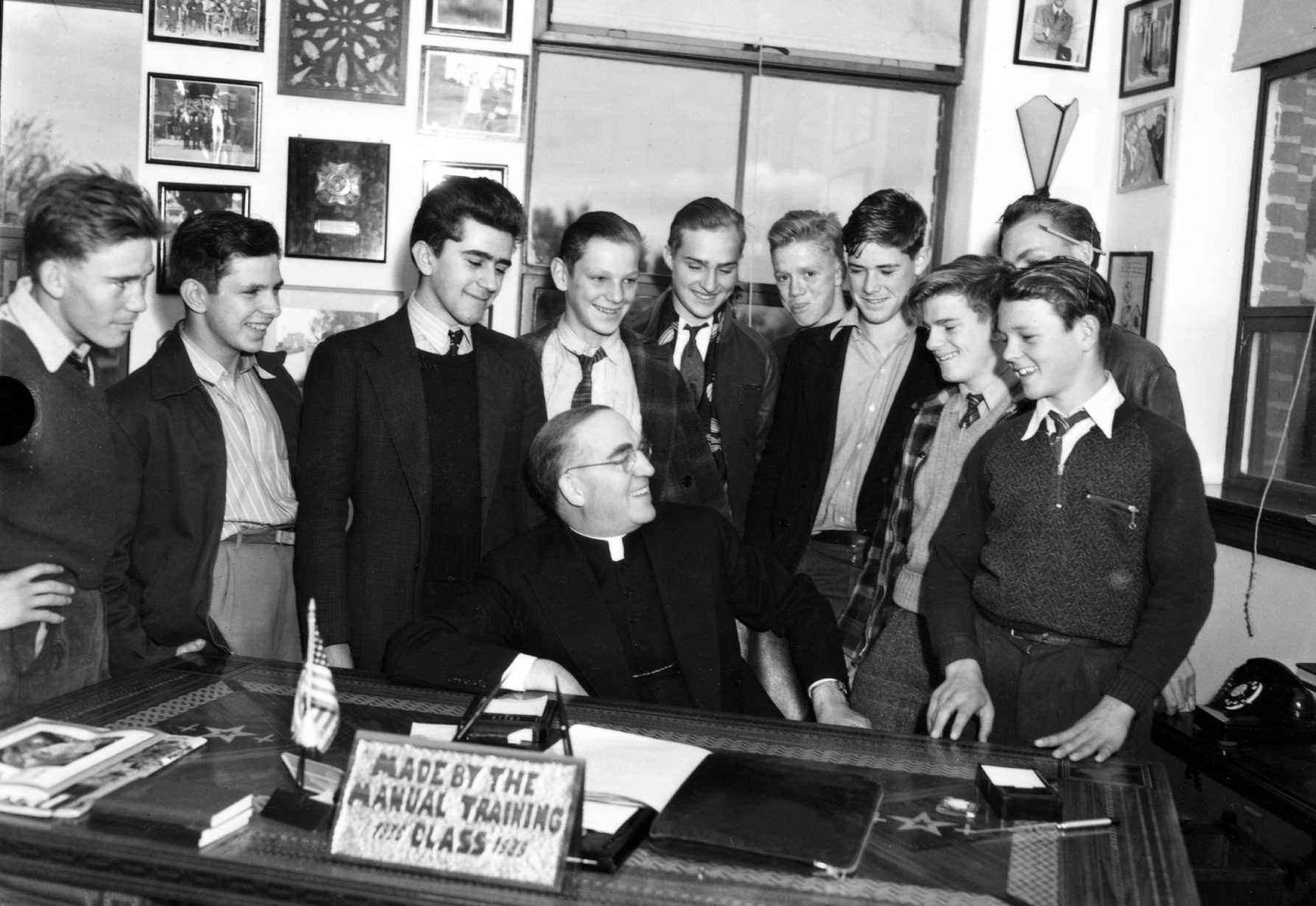
Father Edward Flanagan is surrounded by young men in his office at Boys Town in Omaha, Neb., in this 1942 photo. He is at the desk made for him by some boys at the home in the mid-1930s. Father Flanagan founded Boys Town in 1917, devoting his life to the care of troubled and abandoned boys. The Archdiocese of Omaha opened the first phase in the rigorous process toward sainthood in 2012. (CNS photo/courtesy of Boys Town)
VATICAN CITY (CNS) -- Pope Leo XIV advanced the sainthood cause of Father Edward Flanagan, the Irish-born founder of a pioneering home for at-risk boys in the United States, recognizing that he lived the Christian virtues heroically.
The Vatican announced March 23 that the pope authorized the Dicastery for the Causes of Saints to promulgate the decree, a key step on the path to sainthood.
Born in 1886 in Ballymoe, Ireland, Father Flanagan immigrated to the United States, first moving to New York. He contracted double pneumonia during his first year of seminary and due to "weak lungs," doctors told him he would have to leave for at least a year, according to the Father Flanagan League Society of Devotion website.
He moved to Omaha to live with his brother, who was also a priest and his sister, who was his housekeeper. He was ordained a priest for the Diocese of Omaha. Initially working with men who were experiencing homelessness, Father Flanagan became convinced that the roots of homelessness often began in childhood and could be addressed early in life.
“There are no bad boys,” he said. “There is only bad environment, bad training, bad example, bad thinking.”
In 1917, he founded Boys Town near Omaha, Nebraska, creating a community for orphaned and at-risk boys that broke with the traditional model of reform schools and orphanages. The village included its own student-run government and civic structures, along with nationally recognized music and sports programs.
Father Flanagan was also known for his forward-looking commitment to racial and religious inclusion. He welcomed Jewish and Black youths at a time of widespread segregation, drawing threats from the Ku Klux Klan, and insisted that boys of different faiths be free to pray according to their traditions.
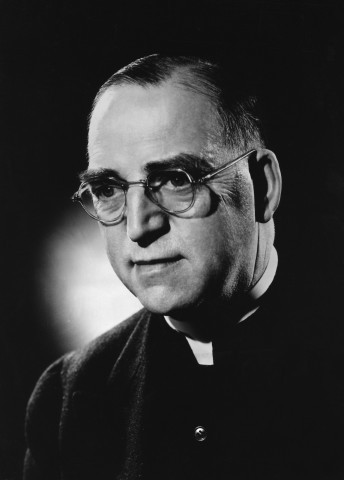
During World War II, he opposed the internment of Japanese Americans and provided housing for nearly 200 displaced Japanese-Americans at Boys Town.
Father Flanagan died in 1948 in Berlin. Today, Boys Town now welcomes girls, and it has expanded across the states, including in Florida, Iowa and New York.
His work gained national attention in the 1938 film “Boys Town,” with Spencer Tracy winning an Academy Award for his portrayal of the priest.
In the same Vatican announcement, Pope Leo XIV also recognized the heroic virtues of Father Henri Caffarel, founder of the Équipes Notre-Dame movement; Sister Barbara Stanislava Samulowska, a member of the Daughters of Charity of St. Vincent de Paul; Spanish Sister Maria of Bethlehem of the Heart of Jesus Romero Algarín, a member of the Congregation of the Handmaids of the Divine Heart; and Giuseppe Castagnetti, a 20th century Italian layman and father.
The pope also approved a decree recognizing "the offering of life" of Cardinal Ludovico Altieri, a 19th-century bishop of Albano, Italy. The "offering of life" (oblatio vitae) category indicates a candidate who heroically offered his life out of loving service to others. He died in 1867 after coming to the aid of his parishioners, administering the sacraments and running emergency care during a severe cholera epidemic in Albano.
The Catholic Church recognizes several paths in sainthood causes. Most commonly, a candidate is declared “venerable” after the recognition that a Servant of God heroically lived a life of Christian virtues. A miracle attributed to the candidate's intercession is normally required for beatification, with a second miracle needed for canonization.
Martyrs, those killed out of hatred for the faith, may be beatified without a miracle.
The third, less common way, is called an equivalent or equipollent canonization: when there is evidence of strong devotion among the faithful to a holy man or woman, the pope can waive a lengthy formal canonical investigation and can authorize their veneration as saints.
In 2017, Pope Francis introduced a new, fourth pathway to sainthood, known as the “offering of life,” recognizing those who freely gave their lives for others; it also requires a miracle for beatification.