Pope Leo urges ban on lethal autonomous weapons, stronger AI oversight
The pope renewed his call for caution in using artificial intelligence, going a step further by suggesting a ban on autonomous lethal weapons.

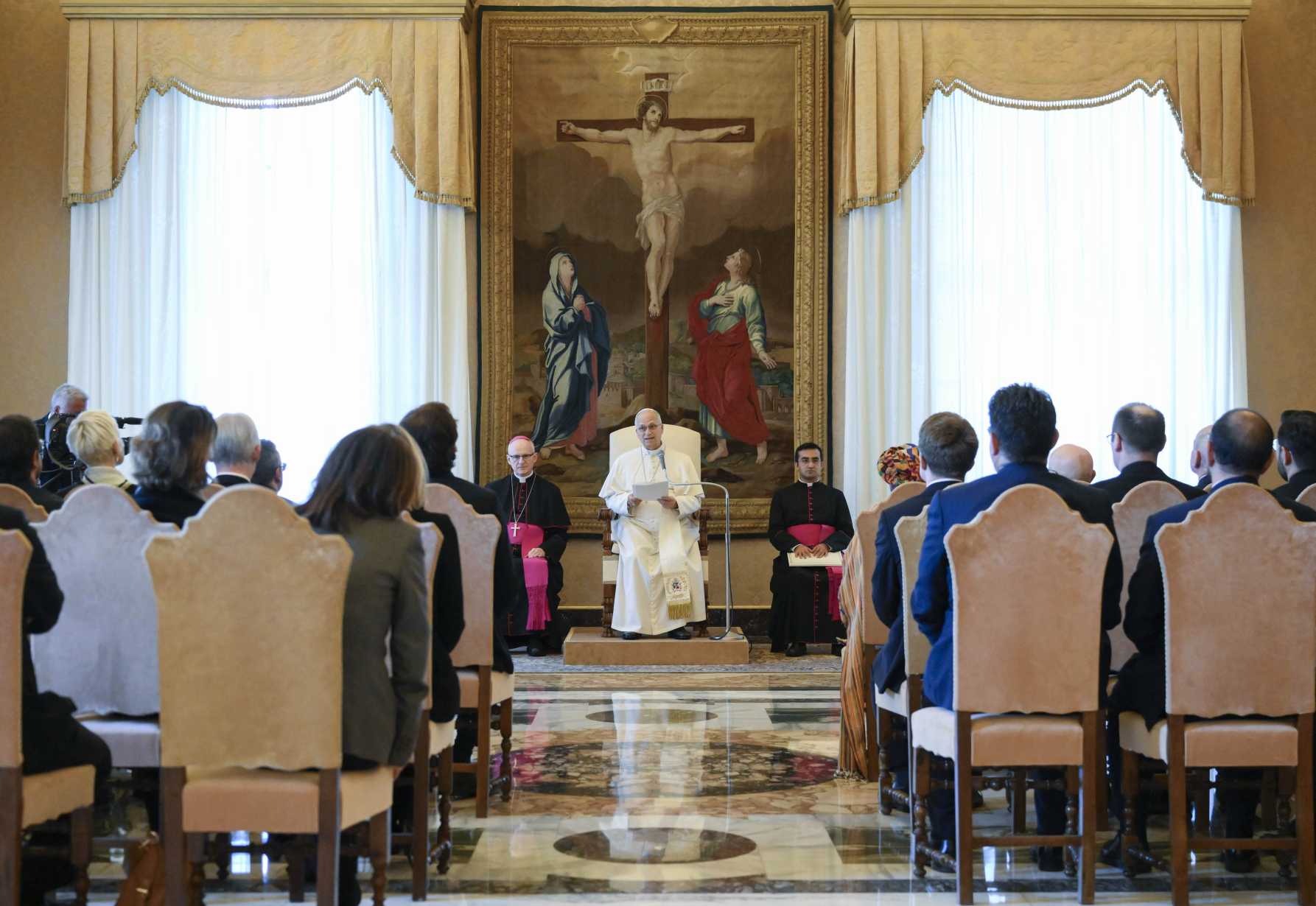
Pope Leo XIV gives an address to the Pontifical Academy for Life and the nonprofit Future of Life Institute Oct. 30 at the Vatican, calling on world leaders to ban lethal autonomous weapons. (CNS photo/Vatican Media)
VATICAN CITY (CNS) -- Pope Leo XIV called on world leaders to take concrete steps toward banning lethal autonomous weapons, warning that decisions affecting human life and freedom must never be left to artificial intelligence.
"Decisions affecting human life, freedom and the use of force must always remain subject to effective, informed and responsible human oversight," the pope told scientific experts and Vatican representatives during an audience at the Vatican Oct 30.
The experts were in Rome taking part in a meeting -- organized by the Pontifical Academy for Life and the nonprofit Future of Life Institute -- to discuss the future of AI, its development and application.Artificial intelligence must be "disarmed," Pope Leo said, encouraging leaders meeting in Geneva in November to take concrete steps toward prohibiting lethal autonomous weapons, because the future of artificial intelligence is "not pre-determined."
"As a technology developed by human beings, its future depends on the choices we make," he said.
The Vatican has repeatedly spoken out against AI weapons, including during the papal trip to France, where the pope warned against losing humanity amid what he called a “paradise of machines” and said ethical discernment is indispensable if technological progress is to promote integral human development.
Recalling Pope Francis' 2024 address to G7 leaders, in which his predecessor described artificial intelligence as both an "exciting and fearsome tool," Pope Leo reaffirmed in his Oct. 30 address that no machine should be entrusted with deciding whether to take a human life.
The pope's remarks were part of a broader appeal for stronger international institutions capable of translating ethical principles governing artificial intelligence into enforceable standards.
"We already know many of the ethical principles that should guide the development of artificial intelligence," he said. "What we currently need are institutions capable of putting these principles into practice."
Such institutions, he said, must establish shared standards, independent oversight and clear accountability mechanisms that allow decisions involving AI to be examined and challenged, with appropriate remedies available when harm occurs.
Reflecting on his encyclical "Magnifica Humanitas," Pope Leo outlined considerations for the development and regulation of artificial intelligence, emphasizing that the direction of technological progress remains a matter of human choice.
Rather than treating AI development as a technological competition, he urged developers and policymakers to consider whom such systems serve and who risks being left behind.
"A reliable system that serves the human person is of greater value than one that is exceptionally powerful but whose consequences cannot be adequately foreseen or controlled," he said.
The pope also cautioned against proposals to grant AI systems rights or legal personhood, arguing that machines cannot be equated with human beings.
"Machines are tools, not persons," he said.
Granting artificial intelligence legal personhood, he warned, risks obscuring human responsibility and leaving people harmed by such systems without clear avenues for accountability.
"So-called artificial intelligences do not undergo experiences, do not possess a body, do not feel joy or pain, do not mature through relationships and do not know from within what love, work, friendship or responsibility mean," he said, quoting his encyclical.
The pope also reiterated his belief that the benefits of technological development must be shared equitably, rather than concentrated in the hands of a few.
"Justice requires access to the benefits of innovation, including care, knowledge, tools and opportunities," he said, quoting his encyclical.
He ended by saying that what perhaps is most urgent is finding institutions capable of placing ethical guardrails into practice to "safeguard the global common good."