Jesus shows how to give life and freedom, not dominate and destroy, pope says
People tend to consider themselves powerful when they dominate, victorious when they destroy and great when they are feared, Pope Leo XIV said during the Mass of the Lord's Supper on Holy Thursday April 2.
Christ, however, shows a different kind of power: unconditional love and service that transforms hearts and inspires the faithful to experience and share what true love is, he said before washing the feet of 12 priests at the Basilica of St. John Lateran.
 Carol Glatz
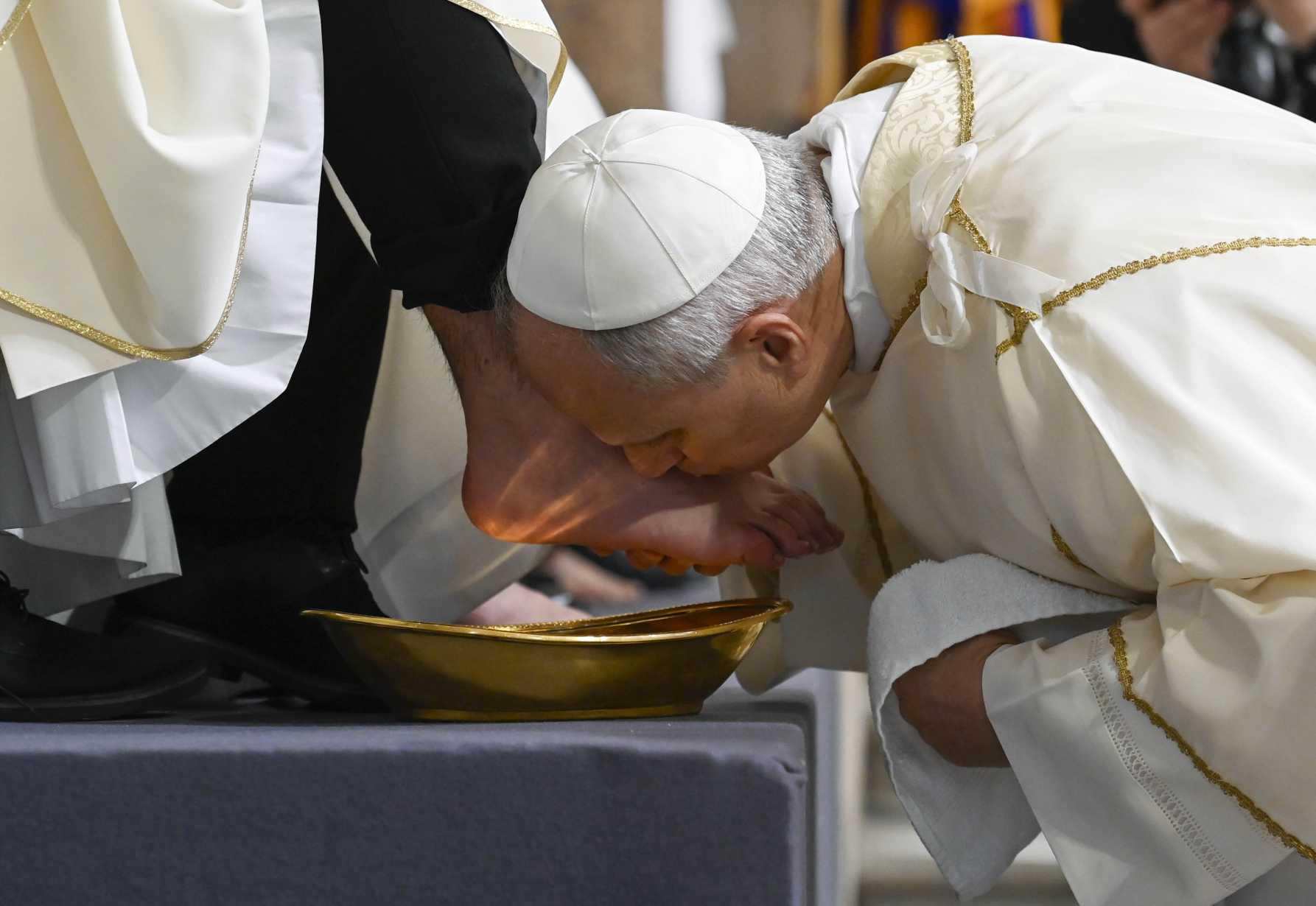
Pope Leo XIV kisses the foot of a priest during the Mass of the Lord's Supper at the Basilica of St. John Lateran in Rome April 2, 2026. The foot-washing ritual reflects the call to imitate Christ by serving one another. (CNS photo/Vatican Media)
ROME (CNS) -- God doesn't exist to grant victories or to be useful by providing wealth or power, Pope Leo XIV said.
Through Jesus, he serves humanity by offering himself in a way that transforms human hearts so that they may then be inspired to love others unconditionally, in turn, he said in his homily during Mass of the Lord's Supper in the Basilica of St. John Lateran.
"Jesus purifies not only our image of God -- from the idolatry and blasphemy that have distorted it -- but also our image of humanity," he said April 2, Holy Thursday. "For we tend to consider ourselves powerful when we dominate, victorious when we destroy our equals, great when we are feared."
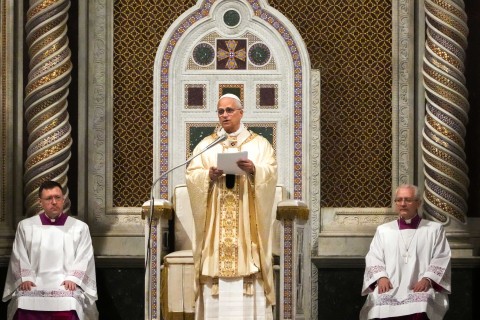
However, he said, "Christ offers us the example of self-giving, service and love" so that humankind can learn how to love according to what true love is.
In fact, he said, learning to act like Jesus "is the work of a lifetime."
The Lord loves not because those he reaches out to are good or pure, Pope Leo said, but simply because "he loves us first."
"His love is not a reward for our acceptance of his mercy; instead, he loves us, and therefore cleanses us, thereby enabling us to respond to his love," he said. "He does not ask us to repay him, but to share his gift among ourselves."
"In him, God has given us an example -- not of how to dominate, but of how to liberate; not of how to destroy life, but of how to give it," Pope Leo said.
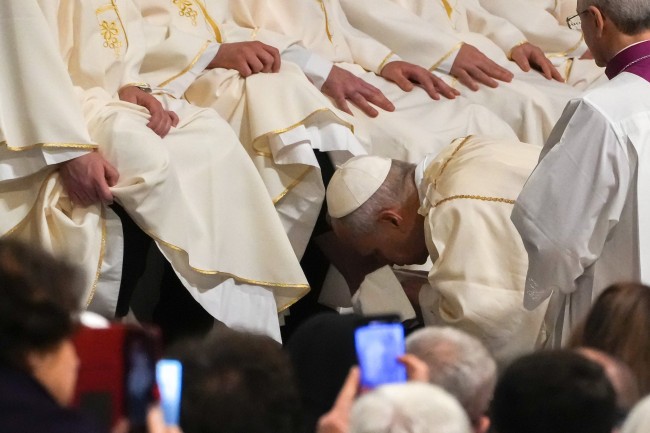
"As humanity is brought to its knees by so many acts of brutality, let us too kneel down as brothers and sisters alongside the oppressed," he said. "In this way, we seek to follow the Lord's example."
The pope's words came during a Mass that commemorates Jesus' institution of the Eucharist and the priesthood, and includes the traditional foot-washing ritual, which reflects the call to imitate Christ by serving one another.
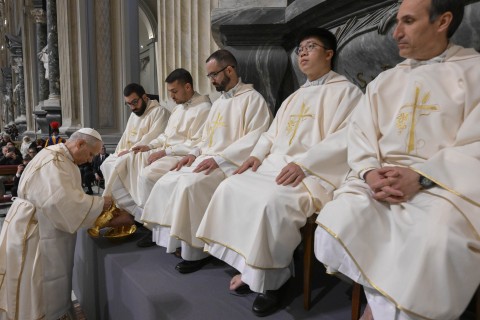
Pope Leo returned to an earlier practice of washing the feet of 12 priests from the Diocese of Rome in the Basilica of St. John Lateran, which is the cathedral of the Diocese of Rome. The pope poured water from a golden pitcher onto the foot of each priest, wiped each foot dry with a towel and then gently kissed each foot.
Pope Francis had departed from the norm after his election in 2013 by celebrating the Mass in one of Rome's "peripheries," such as prisons or nursing homes, and by washing the feet of men, women and their infants, Muslims or people of no faith, as a sign of his dedication to serve everyone unconditionally.
Pope Francis' predecessors had always chosen either 12 priests, laymen or boys from the diocese for the ritual held either in the Basilicas of St. John Lateran or of St. Peter.
By choosing 12 priests, 11 of whom he ordained last year, Pope Leo highlighted the Mass' commemoration of the institution of the Eucharist and of holy orders.
"The intrinsic bond between these two sacraments reveals the perfect self-gift of Jesus, the high Priest and living, eternal Eucharist," he said in his homily.
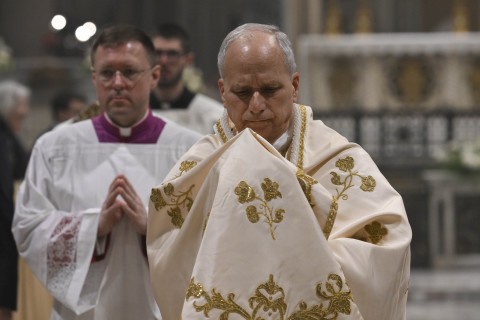
"Beloved brothers in the priesthood, we are called to serve the people of God with our whole lives," he said.
Jesus' disciples were astonished by their master's gesture and, like Peter, "we too must 'learn repeatedly that God's greatness is different from our idea of greatness … because we systematically desire a God of success and not of the Passion,'" he said, quoting Pope Benedict XVI.
"We are always tempted to seek a God who 'serves' us, who grants us victory, who proves useful like wealth or power. Yet we fail to perceive that God does indeed serve us through the gratuitous and humble gesture of washing feet," he said. "This is the true omnipotence of God."